Toronto
Messengers –A Brief History
|
||||||
| Part 1 – 1800’s - 1950
EARLY HISTORY
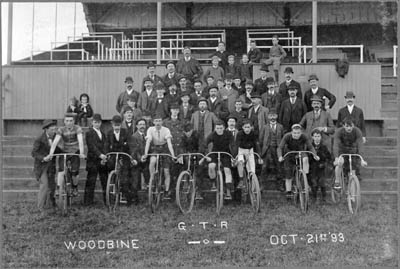
By Joe Hendry Bicycle and foot messengers in Toronto boast a long and proud history demonstrated by a love for riding and racing while struggling for fair and equitable treatment under the law. Like most cities foot messengers were among the first inhabitants. In fact most scouts both native and European, could also be considered foot or mounted messengers. Their history can be traced to the beginning of time. The earliest documented bicycle messenger service in North America dates back to 1880. According to the National Archives of Canada Library, H.T. Baily advertised a bicycle livery and messenger service that was open all night and all day on the streets of Toronto in 1880. Canada’s first telegraph company, the Toronto, Hamilton and Niagara Electro-Magnetic Telegraph Co, formed in 1846 ushered in the era of the telegraph messenger at first on foot and later on bicycles too. FIRST MESSENGER RACE By 1895 bicycle messengers from rival Toronto telegraph companies were racing each other. In the first documented bike messenger race the Great North Western Telegraph Company (GNW) messengers challenged the Canadian Pacific Railway Telegraph (CPR) messengers to a bicycle race at the Toronto island track. This race was followed in June 1896 by GNW company races on the Rosedale track. By 1902 both GNW and CPR were holding annual messenger championships for their bike messengers at either the Rosedale, Woodbine or island tracks. At the time each company employed about 45 to 50 bicycle messengers who owned their own bikes. At the turn of the century Toronto’s messengers did more than just telegraph work. The city also had regular bike courier companies that delivered letters and parcels to just about anyone. The Dominion Distribution Company (located at 26-28 and later 34 Adelaide St. W.), Reliable Messenger Company (11 Leader Lane), Beaver Messenger Company (Richmond St. E.), Holmes Electric Delivery Express Service (12 King St. E.) and City Messenger Service (12 ½ Teraulay) were just a few of such companies. City Messenger Service (CMS) employed 15 couriers on “wheels” that were owned by the company. Like today’s bike messengers these couriers worked long hours and delivered in every kind of weather imaginable. Both the telegraph messengers and bicycle couriers were paid on commission. The average age of the CMS messenger was 15 years-old. Department stores like Simpsons (at Yonge, Queen and Richmond) and Eatons (at Temperance and Yonge) also employed bicycle messengers well into the night. The long hours and young ages of some messengers drew the attention of child labour advocates all over North America. By 1904 advocates such as Florence Kelly of New York were traveling to Toronto to call for boycotts of companies that used children as messengers and in 1911 the post office instituted a standard that “no post office messenger boy is supposed in the discharge of his duties, to walk more than ten miles a day or cover more than twenty-four miles on a bicycle.” Businesses recognized the selling power of the bike messenger early. In the early 1920’s C.C.M. advertised their bikes to boys as an opportunity to get a job as a bike messenger. The C.C.M dealer would even allow boys to pay for their bikes weekly or monthly if they got a job as a messenger. In the 1930’s Eaton’s advertised special “messenger boys’ rain capos” as a means to stay dry while riding. In the 1920’s and 1930’s bike messengers were everywhere in Toronto. In addition to telegraph messengers and bicycle courier services many businesses employed their own messengers to make deliveries. One of the largest employers of messengers at this time were drug stores. In a 1929 advertisement Tamblyn Drug Stores boasted that it employed 125 bike messengers in Toronto alone and in a 1931 ad they took a picture in front of one of their stores with 42 messengers and their bicycles (one for each store in Toronto). By 1937 Tamblyn claimed to employ at least 300 bicycle messengers in their stores. The large number of messengers together with late night deliveries and cash collections exposed bike messengers to many dangers. In the 1920’s and 1930’s robberies of bicycle messengers were so common they were refereed to as an epidemic with several gangs preying on messengers. In the winter of 1937-38 over 100 bicycle messengers were robbed. Some of the messengers challenged the armed robbers by refusing to hand over money or by throwing their bikes at the robbers and giving chase. At one point it was so dangerous that Toronto moved to ban all night deliveries but later reversed it. The robberies of messengers as young as ten years old continued into the 1960’s with little or no action by government. HEROES Despite the treatment they sometimes receive from the community they serve, Toronto bicycle messengers have shown pride in the profession through history. Messengers have chased bandits, pulled children from on coming streetcars and jumped in the lake to save a drowning swimmer. In many cases the messenger is not identified because after his heroic deed he would continue on his way to his next stop. In 1950 two men robbed the payroll of Acme Farmers Dairy at Walmer Rd. and Macpherson Ave. As bullets flew wildly around pedestrians ran. Messenger Ronald Terry dove under a car and was able to get descriptions of the robbers and the license plate of their car which resulted in their arrest. On a cold night in February 1938 at about 1 am, bike messenger Arnold Goward (yes he was still working at 1 am) witnessed a break-in at a gun shop at Richmond and York Streets. The messenger chased the gun-toting bandits, eventually getting close enough to get their license plate number, which resulted in the arrest later that day. In May of 1938, 19 year-old bike messenger, Robert Thompson demonstrated the courage and determination possessed by many of his peers at that time. On May 11 Thomson fell from his bike into the path of a streetcar. “With his legs almost severed at the thighs, he pulled three telegrams from his pocket and asked someone to see that they were safely delivered.” Toronto’s Chief Coroner, Dr Smirle Lawson proclaimed that “in all my medical experience I have never seen such courage exhibited by a young man.” Dr Lawson went on to say “the wealth of a nation is not in her money but in her people. As long as Canada produces boys with courage and devotion to duty like the late Mr. Thompson we need have no fear for our country’s future.” WORLD CLASS RACERS The 1930’s produced some of Toronto’s best messenger races. Many telegraph messengers of the time were racing enthusiasts. Like many messengers today, they rode fixed gear racing bikes with no brakes. Three of those messengers worked for Toronto’s Canadian National Telegraph (CNT). Bob McLeod, George Crompton and Wesley McLean raced each other and were members of the Maple Leaf Bike Club.
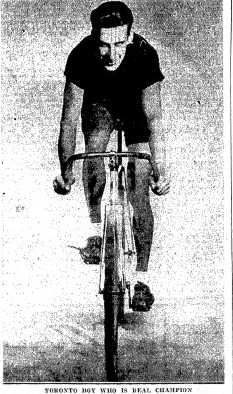
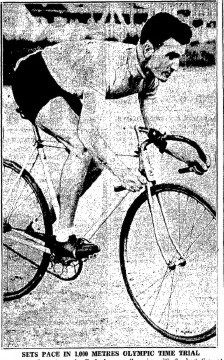
At the 1933 Canadian Cycling Championships Bob McLeod won all three official races (half-mile, mile and two-mile) and George Crompton finished second in the two-mile race. In June 1934 Crompton, McLean and McLeod finished second, third and fourth in a championship race at the Canadian National Exhibition track. McLeod represented Canada at the 1934 British Empire Games (Commonwealth Games). He surprised the world by beating a very strong field to win the premier cycling event of the games – the 10-mile race. In addition McLeod came second in the time trial. When he returned home McLeod received a hero’s welcome. He was carried up Bay St. in flag draped chair by a large group of Toronto messengers (including Crompton and McLean) to the CNT messenger office. All three CNT messengers continued to race each other in 1934 while trading victories at various distances. Crompton and McLeod would be crowned Canadian champions in 1936 and they would go on to represent Canada at the 1936 Olympics in Berlin.
Unfortunately at age 21, Wesley McLean, like many messengers, would be killed by a car while riding home from work in November 1934. The car ran a stop sign and mowed down McLean. Bob McLeod identified his friend’s body at the morgue that evening. At the trial the defense attempted to blame McLean’s death on his fixed gear racing bike, contending that the lack of brakes made it difficult for him to stop. As any messenger today knows McLean would have no trouble skidding to a quick stop. The jury acquitted the driver of manslaughter but convicted him of criminal negligence. After which the judge stated “in my opinion the evidence very well warranted a conviction of manslaughter. Your reckless disregard imposed a duty on the jury and now imposes a duty on me.” The driver received a prison sentence of only four to six months. Bob McLeod also passed away early. He died at the age of 44 in 1958. In 1999 he would be named one of the top 25 Canadian cyclists of the 20th century by Canadian Cyclist magazine. FIRST MESSENGER ASSOCIATION Wesley McLean was one of many Toronto bike messengers killed on the job. During the 1930’s a messenger was killed every year on the streets of Toronto. The danger of robbery, the threat of death and the endless work hours led Toronto messengers in 1937 to form the first bike messenger association. The Toronto Bicycle Messenger Boys Association was formed in 1937. Their main goal was to reduce their work-week from 80 hours to 60 hours. At the time adults were only required to work 40 hours. The couriers worked 12, 14, and 16 hour days, usually working until 2 am on Sunday morning. In addition they were forced to eat their meals on the run and they were often exploited. Some messengers were only paid for half the time that they worked. Others were forced to share their paycheck with a brother who worked for the same company. Part 2 - Toronto Modern History Copyright Mess Media 2004
|