“Hey,
there’s blood on this envelope!”
said Mary, the receptionist.
“Sorry about that, it’s mine,” I
answered, pointing to the blood
dripping from the knuckles on my
right hand.
“But the cheque is here in
plenty of time, right?” I said, in
a plea for some appreciation.
After all, I almost died
getting that multi-million-dollar
cheque to Mary in less than twenty
minutes because she forgot to call
it in sooner.
“Yes, plenty of time,” she said as
she signed my manifest.
I didn’t blame Mary. It’s the
nature of my job as a bike
messenger. My job is to deliver
one hundred percent on time, all
of the time, with no exceptions
and no excuses. I never seek
appreciation but this one time I
hoped for just a little.
Appreciation is something I rarely
experience on the road. I show up
every day ready to ride hard in
every imaginable weather condition
and under any circumstance. In one
sense it is understandable. There
is little time for appreciation
because as soon as I complete one
job there may be a more important
one already waiting.
Deliver or die. It doesn’t matter
if it’s bad weather, traffic,
mechanical problems or any other
extraordinary circumstance. The
client does not care. They
want their package right away;
otherwise they would probably call
UPS or FedEx.
Although customers seldom admit
it, they often rely on the bike
messenger to be their hero. They
need someone to keep them from
going to jail or someone to save
them from losing millions of
dollars or someone to make up for
all the inefficiencies, office
politics and
procrastinations that led them
dangerously close to missing a
major deadline.
Now it’s all on me, the bike
messenger. If I succeed it is
expected and I am on to the next
tag immediately. If something goes
wrong, I’m expected to fix it. I’m
the fall guy. If the client had
the wrong address, or the wrong
contact name, it doesn’t matter. I
will be expected to spend some
time trying to fix the problem and
save the client. Some companies
will charge extra for the time,
others will not. Most will charge
some of the time but ultimately I
will not know if I will be paid
for my extra time and effort until
long after the tag is complete.
Toronto
like most cities has a massive
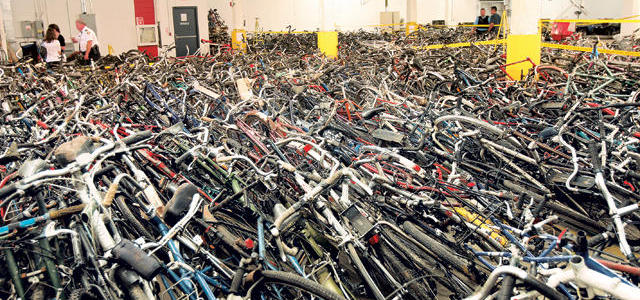
problem with bike theft and many
of its victims are bike
messengers. The possibility of
having my bike stolen is always in
the back my mind whenever my bike
is out of my sight and every time
I walk out of a building I am
relieved to see my bike still
there.
For years most cyclists in Toronto
suspected that Igor Kenk, owner of
a notorious used bike store on
Queen Street West, played a part
in the stolen bike racket. Anyone
that had their bike stolen was
first advised to go and check out
"Igor's bike shop" on Queen Street
just east of Strachan. Despite
what was common knowledge amongst
Toronto’s cyclists, it appeared
that Igor would never be held
accountable for his sketchy
dealings with stolen bikes.
I first
met Igor in 1993 when his shop was
located further west on Queen St
between Shaw and Ossington, across
from the Queen Street Mental
Health Centre. At the time I was
living on Shaw Street, a little
south of Queen Street and I just
started working as a bike
messenger. I was happy to have a
bike shop nearby, especially one
that was often open as late as
midnight.
Everywhere you look the media is
hyping some new aspect of
messenger culture as the next big
thing. And they may be right.
Messenger culture and its youth
oriented styles, street edge and
outlaw image has been making
inroads into the mainstream since
the first Cycle
Messenger World Championships
(CMWC) in 1993 in Berlin
Germany. Since then messenger bags
have become the accessory of
choice for office workers and
students.
And now recently many urban
cyclists have started trading in
their city mountain bikes for the
fixed gear bikes associated with
bike messengers. They even refer
to messenger events as part of
their “fixed gear culture.”
Stylist
John Steinberg describes
messengers as being “ahead of
their time.” He says “They’ve
got that edge. You see something
on a courier. Maybe in a year
later it will hit the
mainstream. They’re slick.
They’re cool. For want of a
better word, they’re cool. The
real world for them is cool.”
Being
a
messenger often is a jumping-off point
for people, or perhaps just something
they're doing while waiting for their
real calling to take off... Some have
gone on to be a bit more well-known,
and some of these are more well-known
than others...
Digital files, cloud computing
and accelerating broadband have
long put bike messengers on the
endangered species list. No
matter how fast a messenger is,
even a triple rush can’t compete
with instantaneous. For
messengers, technology is more
of a threat than wily cab
drivers and potholes.
But, oddly, technology is also
what keeps them around. The
evolution of software and mobile
phones has allowed some
messenger companies to work in
autonomous cells, rather than as
an overhead-heavy hierarchy. A
central headquarters is now
obsolete, and profit-sharing
employees take turns dispatching
and making runs.
“Bike messengers will always
exist,” says messenger
entrepreneur Josh Weitzner,
citing all the inventions that
were supposed to spell the end
for bike messengers but didn’t —
the latest being 3-D printers
with their ability to produce
product prototypes from anywhere
in the world.
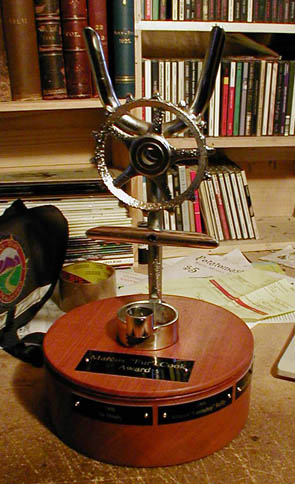
This will be the 13th year that
the award is presented. It was
started by Buffalo Bill in 1998,
to remember Markus and to draw
attention to messengers whose work
benefits all of us.
From
the IFBMA’s Markus Cook Award
page:
“The MCA
for services to the
International Messenger
Community is not a prize
for winning a race. At
the time the Award was
conceived, CMWC was
beginning to be more
about the racing than
the happening. I [Buffalo
Bill] wanted to
re-establish the spirit
of the championships, to
restate the reason that
we all come to this
event every year. The
MCA is a reflection of
the axiom that everyone
who comes to a CMWC is a
winner, whether they
race or not.
Markus
himself was very much in
love with the CMWC, and
in many ways he was the
unlikeliest bike racer
imaginable. He was
several other things, of
course. Editor of
Mercury Rising messenger
zine, unofficial
spokesperson of the
SFBMA, leader of L Sid,
and a friend to all. The
enthusiasm of Markus
brought CMWC and the
international messenger
community to San
Francisco,
and it saddens many
people to this day that
he did not live to see
it.
This award
is for people that
inspire and empower the
wider messenger
community, that put all
of us before themselves.”
La Ocho marks the return of the
figure-8 track and CMWC vistis
LAtin America for the first time.
Congratulations to everyone who
made it there and special thanks
to Nadir and his entire crew for
making it happen. I had nothing to
do with it but I'm still so very
proud of this year's CMWC.
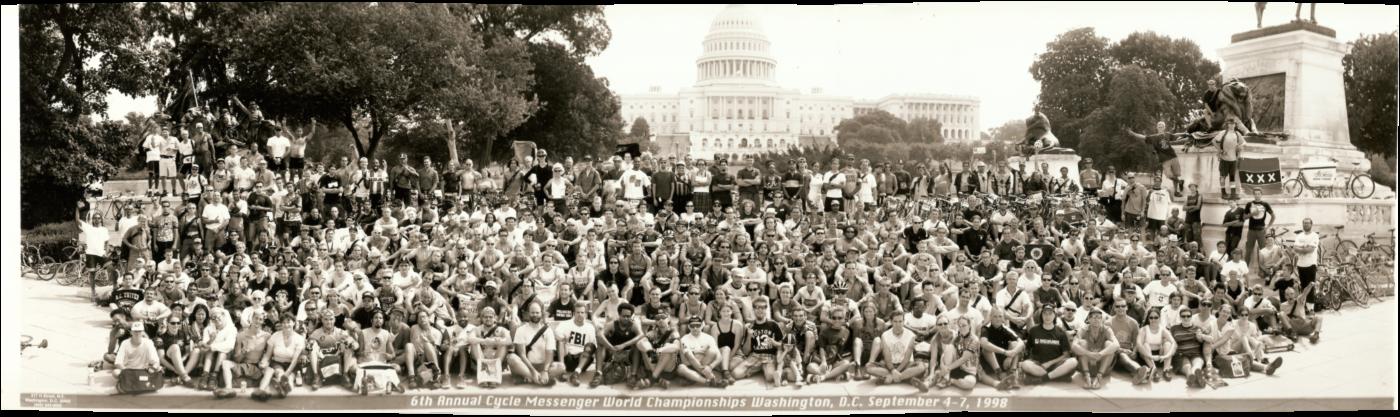
It's not from Panajachel,
Guatemala but anyway here is
the group photo from the 1998 CMWC
in Washington DC.
Toronto cyclists will be holding a
ride of silence for slain cyclist
Darcy Allan Sheppard at 1pm on
Sunday August 29, 2010. The ride
starts at Bloor and Avenue Rd.
The ride will be followed by a
candlelight vigil later that
evening around 7:30pm at Bay and
Bloor.
The ride and vigil will
commemorate the first anniversary
of Sheppard’s
death on August 31, 2009.
Sheppard’s courier friend’s Uncle
Dropsi and Sunny D have release a
song
and video to remember him.
The 33-year old Sheppard was
killed after an attack by former
Ontario attorney general Michael
Bryant.
Witnesses
and video
evidence showed that Bryant
deliberately rammed his car into
Sheppard knocking him to the
ground. Witnesses also described
Bryant as intentionally speeding
the wrong way down Bloor Street,
mounting the curb and crashing
Sheppard into a fire hydrant and
mailbox before fleeing.
Despite video evidence and witness
statements, special prosecutor
Richard Peck dropped
all charges against his
fellow British Columbia-bred
lawyer. Critics of his decision
pointed to Peck’s propensity to
drop charges in high profile cases
involving government and police
officials.
Uncle
Dropsi and Sunny D have teamed up
on a new track about Darcy Allan
Sheppard.
In their own words:
This
track is about our friend Al,
who was run down and killed in a
road rage incident on August 31,
2009. He was killed by the
former Attorney General of our
province (like a state) and the
bastard had the charges dropped
almost a year later. Many from
Toronto’s – and the world’s –
cycling community were
absolutely incensed that there
were no consequences to taking
my friend’s life. Anyone who
knows, knows. This is our take
on it.
When a cyclist is killed
by a driver, justice is nearly
always stacked toward the driver.
And in this case in Toronto, the
scales were tilted even more than
usual.
By Bob Mionske
On August 31, 2009, the worlds of
two strangers collided in the posh
Bloor Street shopping district of
Toronto. In the aftermath, one of
those strangers, a bicycle
messenger, lay dead, while the
other stranger, the former
Attorney General of Ontario and a
rising political star, stood
accused of causing the cyclist’s
death.
About a year later, on Tuesday,
May 25, 2010, Richard Peck, the
special prosecutor appointed to
try the case, dropped all charges
against Michael Bryant, the former
Attorney General accused of
causing the death of bicycle
messenger Darcy Allan Sheppard.
I can’t say I didn’t see this
coming.
From the beginning, this case
involved more than just an
encounter between a cyclist and a
motorist gone awry. As I noted in
When
Worlds Collide , issues of
race, class, and power were a
subtext to this case from the
moment that Bryant shut off his
car’s ignition in the driveway of
a luxury hotel, after fleeing the
scene where Darcy Sheppard lay
dying in the street.
An analysis of Richard
Peck’s brief reveals that he
relied heavily on the unchallenged
statements of Michael Bryant to
come his decision to drop the
charges. Peck cherry picked
evidence to support Bryant’s
claims and either suppressed or
ignored alternative evidence that
challenged Bryant’s version of the
events.
On May 25, 2010, special
prosecutor Richard Peck announced
that all charges against former
Attorney General Michael Bryant
would be dropped ruling that
“there is no reasonable prospect
for conviction in relation to
either of the charges before the
Court.”
Bryant had been charged with
criminal negligence causing death
and dangerous operation of a motor
vehicle causing death in relation
to the death of cyclist Darcy
Allan (AL) Sheppard after a
traffic altercation on August 31,
2009. Most cases end with the
ruling of a judge or jury but this
case ended with the ruling of a
single criminal defence lawyer
acting as an independent
prosecutor.
Peck released an eleven page brief
analyzing some of the evidence and
justifying his decision to drop
the charges without a preliminary
hearing of the evidence. His brief
answered few questions but also
raised many more.
For Kevin Keefe, 57, being a D.C.
bicycle courier means one thing:
freedom.
Keefe has been a bike courier for
24 years. He works for Quick
Messenger Service. Bicycling might
be his business, but he'll never
be caught behind a desk.
"According to a lot of people, I
still haven't grown up!" Keefe
said.
Many bicycle couriers like Keefe
still make daily rounds in
defiance of the digital age. The
Internet may be taking over the
messaging market, but there is
still enough business to keep
D.C.'s bike couriers pedaling.
Bicycle couriers often spend rush
hour weaving through traffic and
cutting across city parks.
Businesses and government offices
use them to move documents and
parcels across town.
To those outside the profession,
couriers' work might seem
dangerous.
"Most friends outside of this job
think I'm crazy for doing it, for
biking like an idiot downtown in
traffic," said Patrick Peoples,
24, a courier for LaserShip Inc.
"For me, it's a rush."
Couriers work as independent
contractors for dispatch services
and take jobs as customers place
orders. Dispatchers contact
individual couriers who choose
specific deliveries to make.
Each day bicycle
messengers are faced with the
challenge of riding through
unpredictable traffic to get time
sensitive packages to clients. The
Bicycle
Messenger Emergency Fund is
a 100% volunteer-run, registered
charity (no. 20-0842274) that has
been around for a decade. When the
unfortunate day comes where a
messenger is injured on the job,
the BMEF aids individuals to
lighten the financial burden when
they must take time off to recover
properly.
Toronto's Courier Massive
is holding its first annual
fundraiser for the BMEF MAY 1st,
DUFFERIN GROVE PARK
Polo all weekend 11am to 5pm
Alleycat registration @5pm
Gun goes off @6pm
$10 minimum to enter events
President
Obama’s budget for the 2011 fiscal
year (which begins October 1)
seeks to limit widespread abuses
by employers who misclassify
employees as independent
contractors in order to evade
their responsibilities.
In a video chat, Labor Department
Secretary Hilda Solis noted that a
budget is much more than numbers.
It “is an expression of the
department’s priorities.” Solis
was clear that one of the Labor
Department’s top priorities will
be the independent contractor
issue.
As part of the 2011 Budget, the
Departments of Labor and Treasury
are pursuing a joint proposal that
eliminates incentives in law for
employers to misclassify their
employees; enhances the ability of
both agencies to penalize
employers who misclassify; and
restores protections to employees
who have been denied them because
of their improper classification.
The Labor department would receive
about $25 million and 100
additional enforcement personnel
to work in support of a new
“multi-agency initiative to
dramatically strengthen and
coordinate federal and state
efforts to address employer
misclassification of workers. “
Jane Oates, assistant secretary of
the Employment and Training
Administration said that “the goal
is to improve capacity to identify
misclassification through
increased information sharing and
targeted audits in high-risk
industry sectors. These efforts
will prevent misclassification,
increase statutory enforcement
where appropriate, and enable
collection of payroll taxes
previously lost due to
misclassification, such as in the
Unemployment Insurance program.”
On August
31, 2009, former attorney general
for Ontario, Michael Bryant,
killed cyclist Darcy Allan
Sheppard in one of the most
violent and horrific cases of road
rage in Toronto's history.
Neither Michael Bryant nor his
wife, entertainment lawyer Susan
Abramovitch, gave statements to
police regarding the circumstances
that led to Darcy Allan Sheppard’s
death. They will have many months
to tailor their testimonies to fit
the known evidence and weave it
seamlessly into a vigorous defense
mounted by one of the most elite
criminal lawyers in the country.
Bryant’s victim, Darcy Allan
Sheppard, who was known as Al to
his friends, will not have a voice
at the trial. He will not have an
opportunity to challenge Michael
Bryant’s carefully scripted and
rehearsed testimony. He will not
have a chance to correct Bryant's
devoted wife and an experienced
lawyer when she unconditionally
supports her husband of twelve
years on the witness stand.
Al’s voice needs to be heard. It's
important that people have an
opportunity to understand his
life's last moments. Al could have
been any one of us. He just
happened to be the cyclist who
crossed paths with a driver on the
verge of a road rage meltdown.
I have attempted to rebuild those
last moments of Al's life from his
point of view. All of the events
are based on the factual evidence
contained in security camera
video, witness statements and news
reports. Al's point of view is
also primarily based on the
factual evidence as well as my own
experiences as a bike messenger
and cyclist.
Couriers pointed to a unique
vulnerability due to exposure to
both the ground-level ozone
and particulate matter
present in smog and to exposure to
peek levels of pollution together
with long-term exposure to non
peak levels.
“Bicycle couriers work all day,
year round in the midst of smog.
Our lungs have minimal opportunity
to recover from the effects of
polluted air. We are chronically
exposed to high doses of
dangerously polluted air for long
term, extended periods of time.”
The athletic nature of the
profession requires messengers to
“spend more time outdoors, breathe
faster and engage in vigorous
physical activity.”
This danger to couriers is
exacerbated by the location of the
athletic activity which means that
a bike courier’s “lungs are not
more than about 10 feet from an
exhaust pipe for most of the day.”
Since the release of “Choking us
to death,” many studies have
confirmed couriers’ concerns.
Strong, brave,
fast and free. No wonder we admire
messengers and their style
For
years civilians have watched and
immitated the functional fashion
of bike messengers. From bags to
clothing to accessories the bike
messenger's influence on urban
lifestyle continues to grow. Why?
Jeffrey Kidder's paper in the
Journal of Contemporary
Ethnography, "Style
and Action: A Decoding of Bike
Messenger Symbols" concludes
that "messenger style is
intertwined with messenger
practice." The marriage of style
of and function lends an
authenticity to messenger style.
And it's a piece of this
authenticity that civilians seek
in their immitation of messengers.
In the introduction to the
photography book, "Messengers
Style", Valerie Steele,
Chief Curator of the Museum at the
Fashion Institute of Technology,
notes that "when high fashion
draws on street style, it’s not
only because there is something
special about the clothes. It is
the lifestyle and attitude
associated with subcultural
clothing styles which attracts
attention. Sometimes straight
people want to live the life."